If you're planning to move house right now, you probably didn’t anticipate the global fuel crisis coinciding with your move. Fuel prices across Australia have soared since early March 2026, driven by the conflict in the Middle East and the closure of the Strait of Hormuz. Removal companies, which run diesel-heavy fleets, are feeling every cent of it. Will the rising fuel prices affect the cost of your move? How can you prepare for it?
Here's how the rising fuel costs might affect your moving house plans, what questions to ask before you sign anything, and how to keep costs under control.
Why is fuel going up in Australia?
Australia imports more than 90% of its refined fuel. That's one of the highest dependency ratios of any developed nation. When something disrupts global oil supply, we feel it fast.
The disruption now is the Strait of Hormuz, a narrow stretch of water between Iran and Oman where 20% of the world’s traded oil passes through. Since late February 2026, conflict in the Middle East has effectively shut it down to commercial shipping.
This has hit Australian prices almost immediately. In Melbourne, diesel at the terminal gate jumped from 165 cents per litre in early March to around 311 cents per litre by the end of March. That’s an 88% increase in four weeks.
Petrol hasn't been spared either. The national average has pushed past $2.53 per litre, with some regional Victoria areas already sitting above $3.00.
What is the price of petrol in Australia?
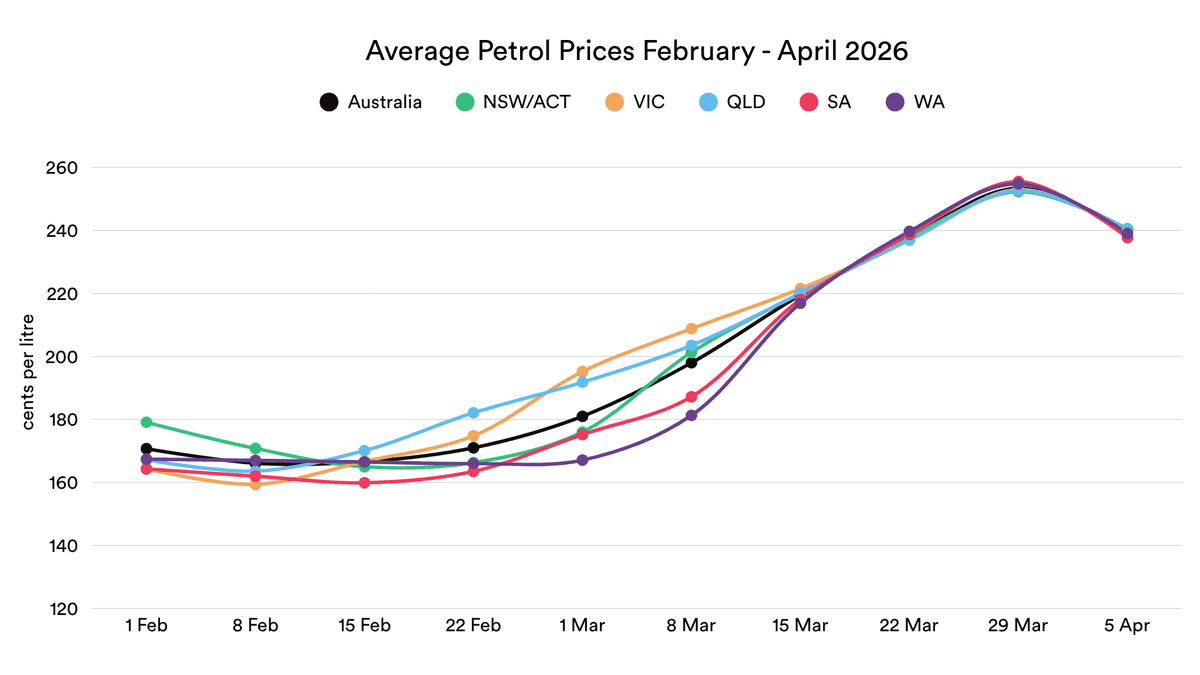
By early April 2026, petrol was averaging around 240 cents per litre nationwide. It’s down from a peak of 255 cents in late March after the federal government's fuel excise cut came into effect on 1 April. Here are the average fuel prices by state in early April:
- NSW: 240.5 cents per litre
- VIC: 240.2 cents per litre
- QLD: 240.2 cents per litre
- WA: 239 cents per litre
- SA: 237.7 cents per litre
How does the fuel crisis affect the cost of moving house?
Most removal trucks run on diesel. When diesel prices spike the way they have in the past month, that cost can end up in your invoice. Here’s how it might play out.
How fuel costs are affecting removalist quotes
If you’re using a local removalist in Melbourne, fuel is usually included in their hourly rate or fixed quote. If you're hiring a truck yourself, you're filling the tank before you return it. Either way, you're paying for fuel; it's just not always obvious where.
What changes during a fuel crisis is the baseline those quotes are built from. Removalists price jobs based on what it costs to run their trucks. When diesel costs over 300 cents per litre, that quote might look different to what it did six months ago. Depending on the removalist, you might not see the words "fuel surcharge" on your quote, but you might be charged a higher base rate.
For interstate and long-distance moves, some operators do add an explicit fuel surcharge on top of the base rate for every extra kilometre travelled past a certain point. Depending on the moving company, they may increase this surcharge as fuel prices rise. Check whether that surcharge is fixed at the time of booking or calculated at the time of the move.
Local moves: Minimal impact
If you’re moving within the same city, the fuel situation isn’t likely to dramatically change what you pay. Hourly rates for a standard two-person, one-truck job haven’t shifted much amongst the major removalist companies.
The bigger risk for local home or office moves is leaving your booking too late. If prices climb even more before the moving date, and you haven’t locked in a rate, you might find yourself with an unwelcome surprise.
Regional and interstate moves: More noticeable impact
This is where the fuel crisis bites a bit harder. For moves over a certain distance (usually 75km–80 km), fuel surcharges can add to your base cost.
For interstate moves the numbers shift quite a bit. The longer the route, the more affected your move may be by the fuel crisis.
Self-hire trucks might not protect you
A lot of people assume hiring a truck themselves will save money. It can, but it doesn't get you around the fuel problem. When you hire a truck, you're responsible for returning it with a full tank. That means you're buying diesel at whatever the pump price is on moving day, with no negotiation or fixed rate.
A removalist company absorbs and manages that cost across their whole operation. When you self-hire, you wear it all at once at the pump. The savings from cutting out a removalist company may be smaller than expected.
When will fuel prices go down in Australia?
Under the two-week US-Iran ceasefire, the Strait of Hormuz is expected to reopen. But analysts are warning it won’t immediately bring fuel prices down. Supply chains still need to catch up and shipping companies need to feel confident returning to the region. That takes weeks, if not months.
Will fuel prices go down with a ceasefire? It’s not likely. Energy Minister Chris Bowen says fuel prices will only go down when the war is truly over.
How to get the best deal on a move right now
- Get at least three quotes from reputable removalists. There's always a spread between removalist companies, but right now, with operators handling fuel costs in different ways, that gap can be wider than usual. It’s best to shop around.
- Read the fuel surcharge clause carefully. Look for whether it's fixed or variable, how often it's reviewed, and whether there's a cap.
- Ask about the right-sized moving truck for your job. Oversized trucks cost more to run. If you've decluttered and know your volume, ask whether a smaller vehicle could handle it.
- Book for mid-week. Tuesday or Wednesday moves are often cheaper than weekends, and availability is better.
- Ask about transit insurance. With companies under cost pressure, corners can get cut. Make sure your belongings are covered if something goes wrong.
FAQs about moving house and fuel prices
Will my removalist quote go up if fuel prices change before my move?
It depends on your removalist and how far you’re moving. Most local removalists offer a fixed quote. But for interstate or long-distance moves, some might recalculate their fuel surcharge closer to the moving day.
Before you sign anything, ask: "If fuel prices change between now and my moving date, does this quote change with them?" If it can change, ask what triggers an adjustment and whether there's a cap.
Should I delay my move until fuel prices drop?
Only if you have the flexibility. Prices aren't going to fall meaningfully until either the Middle East conflict finds some resolution or the Strait of Hormuz reopens to commercial shipping. If you've got a settlement date, a lease starting, or kids starting at a new school, waiting simply isn't a realistic option.
What is the government doing about fuel prices?
The federal government has halved the fuel excise, reducing the cost of petrol and diesel by 26.3 cents a litre from 1 April to 30 June 2026. They’re also reducing the heavy vehicle road user charge to zero during this time to help truck drivers deal with the fuel crisis. This is expected to reduce the price of a 65-litre tank of petrol by $19.
The ACCC is actively monitoring and has increased their penalties for retailers price gouging.
When will fuel prices drop in Australia?
Fuel prices are only expected to drop meaningfully when there's a real resolution in the Middle East, not just a ceasefire. Plan your move around today's prices and treat anything cheaper as a bonus.
Where can I find the cheapest petrol stations near me?
There are a few good websites and apps you can use to see live prices at stations nearby.
- GasBuddy and Petrol Spy: Best all-rounders for nationwide coverage.
- MotorMouth: Tracks weekly price cycle for Victoria and NSW, so you also know when to fill up.
- Fuel Map (Australia), FuelCheck (NSW), FuelWatch (WA): Reliable, government data.
When is the cheapest time to move house during a fuel crisis?
The same rules that applied before still apply now. Mid-week moves are consistently cheaper than weekends because there's less competition for bookings and no weekend penalty rates.
The extra consideration right now is to book sooner rather than later to lock in a rate before further price increases come into play.
The bottom line
Moving house in Australia right now is more expensive than it was six months ago. That's not going to change quickly, and the industry is still adjusting.
What you can control is how well prepared you are. Know what's in your quote, know what can change, and have a contingency in your budget.