
The size of the truck you hire can make or break your move, affecting cost, time, and safety. In this guide, we’ll show you how to estimate your load, pick the right truck size, maximise space, and plan for a smooth move anywhere in Australia.
Why choosing the right truck size matters
Hiring the wrong sized truck can lead to one of two things. Either you get a truck that’s too small and you need to do extra trips (costing you time and money) or risk damaging your items because of overcrowding. Or you get a truck that’s too big, meaning you pay for space you don’t need and have to manoeuvre narrow streets in vain.
Getting your truck size right means a faster, safer, and more cost-effective move. Here’s how to do it.
Step 1: Estimate how much you’re moving
The first step is understanding how much you need to transport. Use a moving inventory list where you list all the items you’re moving to make estimating the same easier. Better yet, use our inventory calculator to get an idea of how many cubic metres of space you’ll need in your truck.
Moving Inventory Example
| Item type | Quantity | Estimated weight |
|---|---|---|
| Couch - 2 seater | 2 | 120 kg |
| Bed & Mattress - King | 1 | 70 kg |
| Bed & Mattress - Single | 2 | 80 kg |
| Dining Table | 1 | 60 kg |
| Dining Chair | 4 | 40 kg |
| Fridge - Large | 1 | 100 kg |
| Rug | 2 | 20 kg |
| Boxes - Big | 2 | 50 kg |
| Boxes Small | 6 | 60 kg |
| Total | 21 | 600 kg |
Our inventory calculator estimates this move to need 16 m³ or a small truck (excluding other items).
The easiest and most accurate way to know what truck to use is to hire professional removalists. They’ll get a list of the inventory you want to move and use their expertise to calculate how big of a truck you need. Reputable removalists won’t under- or oversell you.
Step 2: Know the common moving truck sizes in Australia
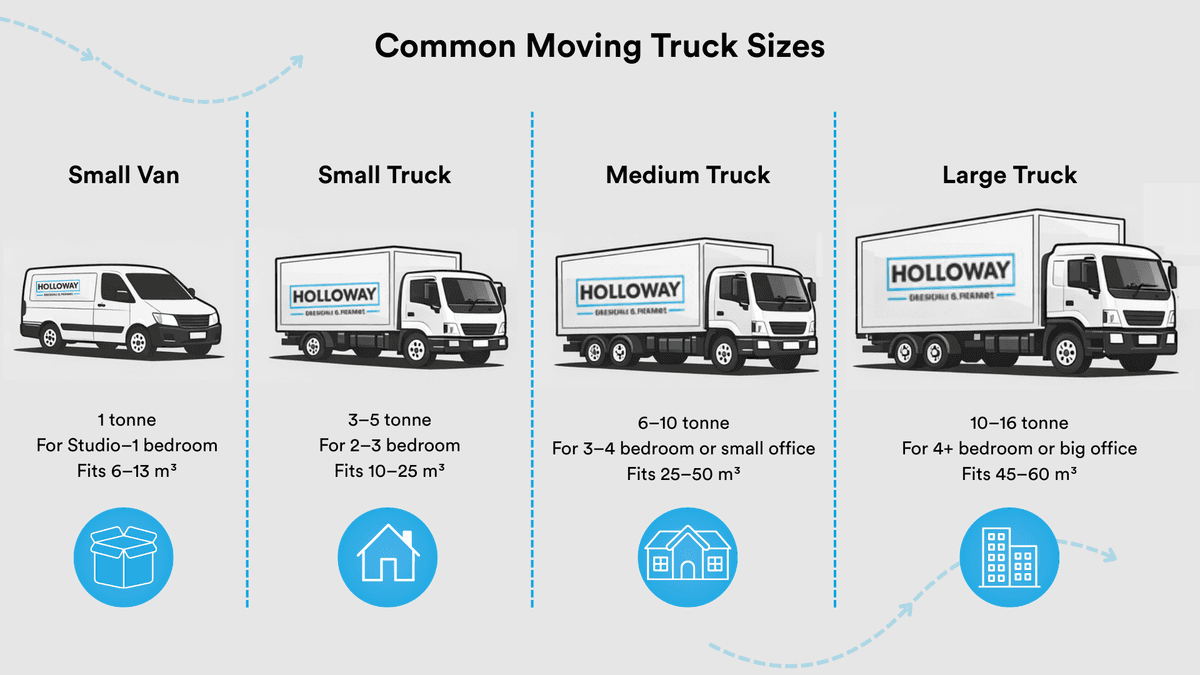
| Truck size | Ideal move | Volume capacity | Typical max cargo payload | Licence class |
|---|---|---|---|---|
| Small van (1 tonne) | Studio–1 bedroom | 6–13 m³ | 700–1,000 kg | C class |
| Small truck (3–5 tonne) | 2–3 bedroom | 10–25 m³ | 1,500–2,200 kg | C class or LR |
| Medium truck (6–10 tonne) | 3–4 bedroom or small office | 25–50 m³ | 3,000–4,300 kg | LR or MR |
| Large truck (10–16 tonne) | 4+ bedroom or big office | 45–60 m³ | 5,000–7,000 kg | MR or HR |
| *Figures are a guide only. Actual capacity varies by truck model, fuel load, and equipment. Always confirm the specific vehicle’s payload before loading. | ||||
For anything larger than a 4.5-tonne truck, you’ll need a special licence. That’s why many people opt to hire professional removalists for bigger moves. They already have the correct licences and experience to handle bigger vehicles safely.
To see how much this will cost, check out how much do removalists cost.
Step 3: Consider local factors
Different Australian cities and the suburbs within them have their own unique moving challenges. In Melbourne and Sydney especially, the inner-city suburbs have narrow streets and tight parking. This can make manoeuvring a large truck tricky, so smaller vehicles are the more practical choice.
Brisbane and Adelaide, on the other hand, have more suburban layouts with slightly wider streets, and can better accommodate medium-to-large trucks.
And if you’re moving to a regional area, the longer distance often means it’s better to hire a pack larger truck that can get the job done in one go.
Step 4: Pack and load to maximise space
You won’t need a bigger truck if you know how to pack and load your items efficiently. For DIY moves (AKA no removalists), you can save space by partially disassembling any furniture you can, like bed frames, table legs, and flat-pack shelves.
Use uniform boxes that stack neatly, place heavier items at the bottom, and lighter, fragile items on top.
Smart loading keeps your belongings safe and ensures you only hire the truck you actually need.
Just remember: even if everything fits, the total weight must stay under the truck’s maximum payload.
Step 5: Planning your move
Not every move is going to go perfectly, but you can make it as close to perfect as possible by planning well and choosing the right truck. Use this quick checklist:
- Book early: Smaller trucks for DIY moves are usually available at least 2 weeks before, but larger trucks (and professional removalists) get booked fast a month before.
- Check access: Make sure the truck can fit in driveways or parking, and plan a clear path from the truck to the door. If your access is restricted, you might need a smaller truck or ferry vehicle.
- Plan your route: Consider streets, bridges, and tight corners that could affect your truck choice.
For a full list of things to do before, during and after you move, try out our Moving Checklist.
FAQ: Choosing the right moving truck
What truck size do I need for a 2-bedroom apartment or house?
A 3–5 tonne truck (10–15 m³) is usually enough for the main furniture and appliances in your 2 bedroom home. Check your inventory first to make sure you choose the right truck.
Can I upgrade the truck if needed?
Yes, many companies let you upgrade your truck, but it’s subject to availability. The earlier you book, the better your chances.
How far in advance should I book?
At least 2 weeks in advance for smaller moves, and 4 weeks for big moves. Book earlier if moving during peak hours or holidays.
What’s included in truck hire?
If you’re hiring just a truck, it usually includes the vehicle, basic insurance, a set number of kilometres, and basic equipment like a trolley.
If booking a truck with removalists, it usually also includes the truck plus labour and more insurance options. In either case, confirm exactly what’s included with your provider before booking.
Final tip: Plan, pack, and move smart
Choosing the right truck size is one of the most important decisions for a smooth move. By listing all your inventory, accounting for local conditions and knowing how to pack efficiently, you can choose the right truck for you; no paying for unused space or taking multiple trips.